Climate Intelligence Score™
The Intelligence Layer for Climate-Aware Decisions.
Assess enterprise climate risk. Map exposure. Translate environmental intelligence into financial and operational decisions.
Your sustainability efforts deserve more than a claim — they deserve a credible rating.
Measure your performance. Demonstrate your progress. Build stakeholder confidence.
Anyone can claim to be sustainable. Very few organizations can demonstrate it with evidence. Climactix Green Rating closes that gap with a structured assessment of an organization's environmental, social, governance, and climate-related performance — producing a rating built on documentation, not adjectives.
Climate Intelligence Score™ is the scoring product behind every Green Rating. It translates assessment findings and supporting evidence into a structured, traceable rating output — not a self-declared number, and not a black-box composite.
The result is more than a badge. It shows where performance stands today, where the gaps are, and what to prioritize next — giving businesses credible, structured evidence to share with customers, investors, lenders, and business partners.
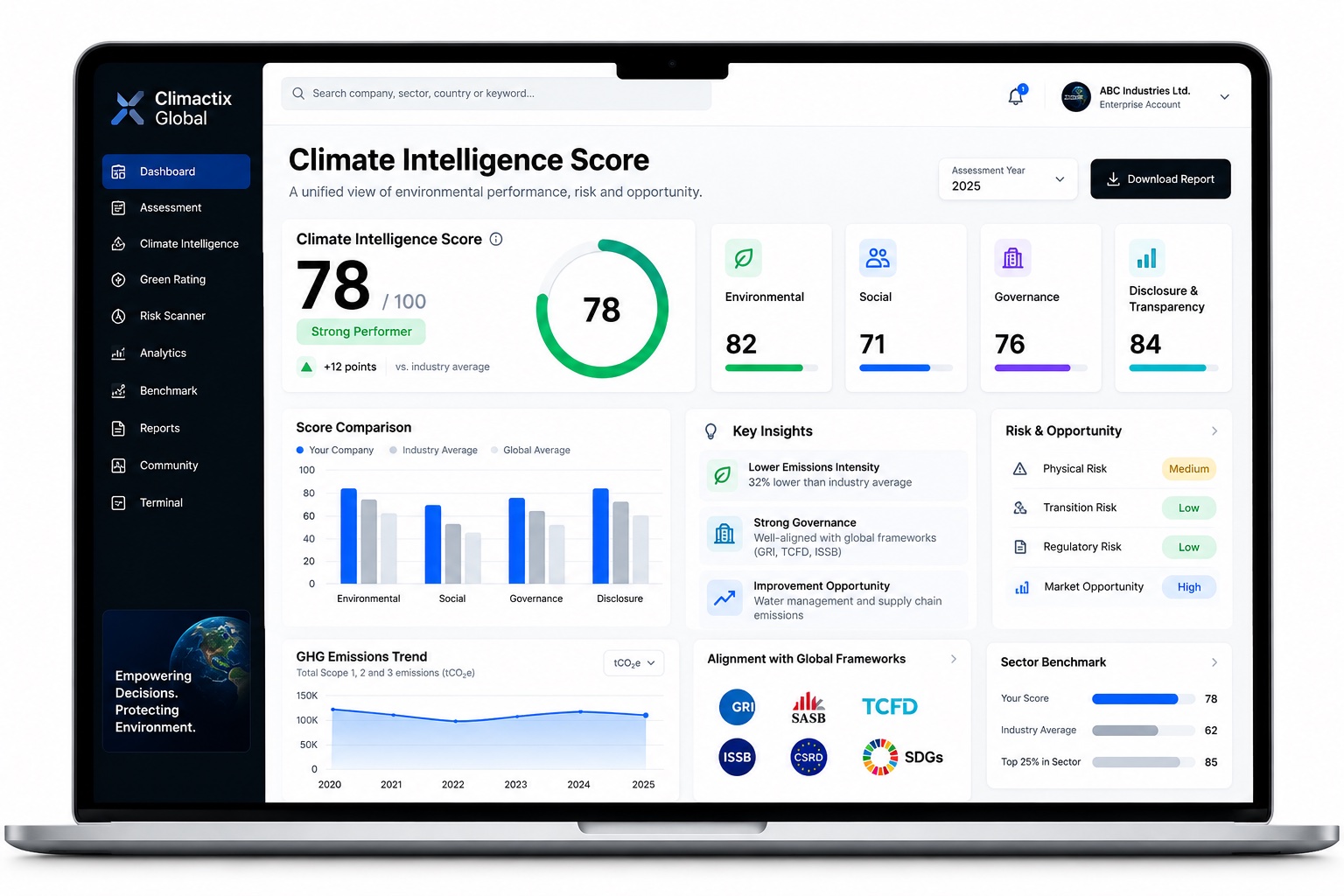
See the score in action
A live preview of the actual Climate Intelligence Score™ interface — the same scoring, benchmarking, and indicator surface every assessment produces.
Climate Intelligence Score™
Climate Intelligence Score™ is a science-based assessment that evaluates an organization's climate resilience, risk exposure, and readiness across key environmental, financial, and governance dimensions.
What You Receive
Completing a Risk OS™ assessment does not produce a single score. It produces a complete Climate Intelligence package — enterprise deliverables built for boards, investors, regulators, and risk committees.
- Climate Intelligence Score™
- Executive Climate Risk Report
- Green Rating
- Physical Risk Assessment
- Transition Risk Assessment
- Financial Materiality Assessment
- Carbon Exposure Summary
- Supply Chain Risk Assessment
- Nature Risk Assessment
- Regulatory Alignment Summary
- Framework Mapping
- Benchmark Report
- Climate Scenario Analysis
- Executive Dashboard
- AI Recommendations
- Continuous Monitoring
Business Value of Climate Intelligence Score™
Unlock Better Financing, Lower Risk, Stronger Market Positioning, and Long-Term Business Resilience.
Climate Intelligence Score™ is more than an environmental assessment. It is a strategic business intelligence framework that enables organizations to unlock financial opportunities, strengthen stakeholder confidence, improve regulatory readiness, reduce climate-related risks, and demonstrate measurable climate leadership.
A stronger Climate Intelligence Score and Green Rating can create tangible business advantages across financing, insurance, investments, procurement, reputation, and long-term enterprise value.
Organizations with stronger Climate Intelligence Scores are better positioned to demonstrate climate resilience and sustainability performance during financing discussions. This strengthens eligibility for sustainability-linked financing, green lending initiatives, and climate-focused investment opportunities.
Climate Intelligence enables financial institutions to better understand organizational climate resilience, helping reduce uncertainty during credit evaluations and supporting more informed lending decisions.
Continuous assessment improves preparedness for evolving climate disclosure requirements, regulatory expectations, and emerging climate-related financial risks.
Institutional investors increasingly evaluate climate resilience alongside financial performance. Climate Intelligence Score™ provides measurable evidence that supports investment analysis, stewardship, and long-term capital allocation.
Climate Intelligence improves understanding of physical and operational climate risks, enabling more informed insurance discussions and stronger organizational resilience.
Climate Intelligence provides structured evidence that can support organizations preparing for sustainable finance initiatives and green capital market opportunities.
A structured Climate Intelligence framework helps organizations demonstrate environmental performance when participating in government sustainability initiatives, climate programs, and future incentive mechanisms.
Organizations demonstrating measurable climate performance strengthen trust with customers, partners, employees, investors, and regulators.
Consumers increasingly prefer organizations demonstrating credible environmental performance. Climate Intelligence Score™ and Green Rating provide transparent evidence that supports purchasing confidence and strengthens brand perception.
Climate Intelligence Score™ transforms climate information into measurable business intelligence for executives, boards, investors, lenders, insurers, and regulators.
Risk OS™ — The Climate Intelligence Operating System
Risk OS™ is the institutional operating system that continuously evaluates organizations using real-world climate, environmental, financial, and operational intelligence. It is the engine behind every Climate Intelligence Score™, every dashboard in the Climactix Terminal™, and the data that powers the Climactix Community™.
Seven products. One operating system.
Risk OS™ powers every product in the Climactix architecture — each answering a different question about climate risk, financial impact, and capital decisions.
Climate Signals, Quantified for Capital and Risk Decisions
Temperature anomalies, sea level trends, and CO₂ concentration data — benchmarked into regional physical risk exposure for enterprises and institutional portfolios. Sourced from IPCC AR6 and NASA GISS. Hover any region for detail.
Above Pre-Industrial
on Record
Rise Rate
2023
Risk OS™ — From Assessment to Green Rating
Risk OS™ evaluates an organization across climate exposure, environmental performance, operational resilience, financial materiality and regulatory readiness — translating evidence into decision-grade intelligence and Green Rating.
Risk OS™ assesses the organization
Simulated walkthrough for a fictional company, ABC Industries. Nine input streams — corporate data, operations, emissions, assets, supply chain, disclosures, climate data, regulatory data and environmental data — are ingested, validated and mapped into Risk OS. Representative assessment questions combine location, climate and asset data into risk signals. Eight analytical modules — physical risk, transition risk, carbon, supply chain, regulatory, governance, nature and resilience — scan their signals, report exposure, severity and confidence, and are correlated. A weighted analysis produces a Climate Intelligence Score of 78 out of 100 and a Green Rating of A, after which the system moves to monitoring. Demo values only.
Risk Intelligence Map — From Climate Data to Risk Intelligence
Combine climate, environmental, geospatial, corporate and operational signals to understand where risks may become material to assets, operations and value chains. Carbon exposure, narrative intelligence and scenario modelling extend the same map: what a company emits, what it says, and how exposure changes under future pathways.
Risk Intelligence Map understands the external risk environment
Simulated walkthrough on the Climactix Earth. A Climactix Earth-observation satellite, CTX-SAT-01, enters orbit, scans a swath, acquires thermal, vegetation, water, land-cover, precipitation and coastal signals and transmits them to Climactix, alongside climate model, weather, emissions, environmental, corporate, supply chain, regulatory and financial data streams. Layers build in sequence: climate signals, Earth observation, exposure and risk. Three analytical layers then act on the same Earth: carbon exposure links assets, emissions, carbon intensity, regulatory exposure and carbon cost to transition risk; narrative intelligence extracts claims from company disclosures and connects each to evidence and data signals on the map, treating gaps as analytical signals; scenario modelling applies pathways from the platform's scenario definitions at 2030 and 2050 for physical, transition or combined risk, changing the hazard field, transition pressure, carbon cost, asset risk and supply chain exposure. Financial materiality and decision intelligence follow. A second pass detects a thermal anomaly over Pune. The view zooms from world to India, Maharashtra, Pune and a fictional ABC Industries facility with high physical, heat and transition risk and moderate water stress and flood exposure. The anomaly flows through facility exposure, heat risk and operational impact to financial materiality and a decision, followed by an illustrative 1.5, 2.0 and 3.0 degree scenario and a synthesis of current exposure, carbon exposure, narrative signal and scenario into climate intelligence, materiality and a decision. All values are synthetic.
- Exposure change►—
- Carbon cost►—
- Asset risk►—
- Supply chain risk►—
-
01Climate signals
- Temperature
- Precipitation
- Drought
- Heat
- Cyclone
- Flood
- Sea level
-
02Earth observation
- Vegetation
- Soil moisture
- Land cover
- Water bodies
- Thermal anomalies
-
03Exposure
- Facilities
- Assets
- Cities
- Transport routes
- Suppliers
- Operations
-
04Risk
- Physical risk
- Transition risk
- Water risk
- Carbon risk
- Supply chain risk
-
05Carbon exposure
- Scope 1 · 2 · 3
- Carbon intensity
- Emissions concentration
- Carbon cost
- Regulatory exposure
-
06Narrative intelligence
- Disclosures
- Claims
- Evidence
- Consistency
- Credibility
-
07Scenario modelling
- Pathway
- Time horizon
- Physical
- Transition
- Carbon cost · policy
-
08Financial materiality
- Revenue at risk
- Cost exposure
- Asset exposure
- Operational disruption
-
09Decision intelligence
- Priority
- Severity
- Materiality
- Scenario exposure
- Action signal
Synthetic data. The satellite, orbit, signals, counters, facility network and risk levels are illustrative product architecture on a fictional company — not live feeds from any satellite, agency or Climactix production system, and not real company data. Carbon, narrative and scenario values are simulated product data; the company disclosures are fictional, scenario pathways come from the platform’s own scenario definitions, and no NGFS dataset is connected. Orbit not to scale.
Two intelligence layers. One decision-grade output.
Assess the organization. Understand its environment. Decide with evidence.
A structured, evidence-based assessment of the enterprise — its operations, emissions, supply chain, governance and disclosures — producing the Climate Intelligence Score™ and Green Rating.
Risk OS™ walkthrough →Geospatial climate and environmental signals mapped against assets, operations and value chains — showing where risk may become financially material.
Map walkthrough →Financial, operational and strategic decisions grounded in assessed evidence and mapped exposure.
FRICS™Farmer Resilience Impact Credits
Securing our food chain.
Financing farmer resilience.
FRICS connects corporate capital with projects designed to strengthen farmer and food-system resilience — an impact-credit marketplace for the resilience of the food chain.
- Project marketplace
- FRICS inventory
- FRICS price
- Company purchase
- Allocation
- Capital deployment
- Impact monitoring
Three products on shared infrastructure, each complete on its own. FRICS is a standalone marketplace: any eligible company can enter it, explore resilience projects and acquire FRICS. No Green Rating is required.
- 01Any company enters the marketplace
- 02Explore resilience projects
- 03Select FRICS
- 04Purchase
- 05Allocate capital
- 06Fund resilience action
- 07Track impact
- 08Strengthen the food chain
Walkthrough of the FRICS marketplace. Water, soil, crop and food-system resilience needs appear on the Earth, then the FRICS Marketplace opens with resilience project categories: water, soil, crop and food supply resilience. A company selects the Water Resilience project, Farmer Water Security, which lists 25,000 FRICS available at a per-FRICS price and an impact focus on water and food resilience. The company enters a quantity of 1,000 FRICS, sees the total value, and buys FRICS. The FRICS move from the marketplace to the company and the status changes from available to acquired. Company capital is allocated through FRICS to the resilience project. The project is deployed on farms through water management, soil resilience and crop adaptation. Securing the food chain starts with resilient farmers: farmer, farm, food, supply chain, company and consumer. Impact indicators — farmers reached, area supported, water resilience, crop resilience and food supply resilience — are reported from project records. The FRICS lifecycle runs from project listed, FRICS available, acquired, allocated, capital deployed and impact monitored to impact verified and completed or retired.
- 01DiscoveryResilience need
- 02MarketplaceExplore projects
- 03ProjectSelect FRICS
- 04Buy FRICSQuantity · total
- 05AcquisitionMarket → company
- 06AllocationCompany → project
- 07DeploymentOn the farm
- 08Food chainFarmer → consumer
- 09ImpactMonitoring
- 10LifecycleCredit stages
Explore resilience projects.
Browse project types by theme, impact and price basis. Open a project to see its objective, interventions, FRICS inventory, price and integrity records — then acquire FRICS. Any eligible company can enter the marketplace.
One credit unit — from listing to impact.
A FRICS is a purchaseable resilience impact credit. Companies acquire FRICS and the associated capital is directed toward farmer, agricultural and food-chain resilience projects. It is a credit unit, not a cryptocurrency.
- Represents
- One unit of capital directed to farmer and food-chain resilience
- Issued against
- A listed resilience project
- Price
- $XX / FRICS — project, methodology or benchmark-linked
- Held by
- Eligible companies
- Recorded in
- FRICS Registry · FRICS-######
- Impact areas
Inventory is open for acquisition at the project price.
A FRICS is not a cryptocurrency, is not traded on an exchange and is not a carbon credit.
From purchase to impact — every step on the record.
The value of the platform is transparency from purchase to impact. Choose a project to follow a purchase through allocation, implementation and monitoring to the food chain it protects.
An impact-credit portfolio for the institution.
Holdings, allocations, projects and impact areas in one view. It is a portfolio of impact credits — not a crypto wallet.
Eight stages. One record.
Every FRICS carries a batch identifier and moves through the same recorded stages, from project listing to completion or retirement. Verification and retirement are recorded only where evidence exists.
Capital.Resilience.Farmer impact.Food-chain security.
FRICS™ is a Climactix marketplace framework. Project types, inventory figures and pricing shown are configuration for projects awaiting connection; they are not issued credits, completed transactions or verified project results. FRICS is not a carbon credit or a cryptocurrency and carries no regulatory recognition or third-party certification.
Six Climate Risks Changing How Capital Moves
These are the physical risk drivers institutional investors now price into capital allocation, underwriting, and credit decisions. Climactix quantifies each as enterprise- and portfolio-level financial exposure — not just a measurement category.
Mapped to Every Major Climate Disclosure and Regulatory Standard
Climactix maps risk and disclosure outputs to the standards investors, regulators, and credit committees require — keeping organizations regulation-ready across jurisdictions without managing each framework separately.
Talk to us about your climate intelligence needs.
Whether you’re a CFO managing mandatory disclosure, an investor who needs clear risk data, or a policymaker building compliance frameworks — we’re here to help. Tell us what you need.